We spend an average of more than seven hours a day in front of screens,…
Presbyopia: why it becomes difficult to focus on close-up objects after the age of 40, and what solutions are available
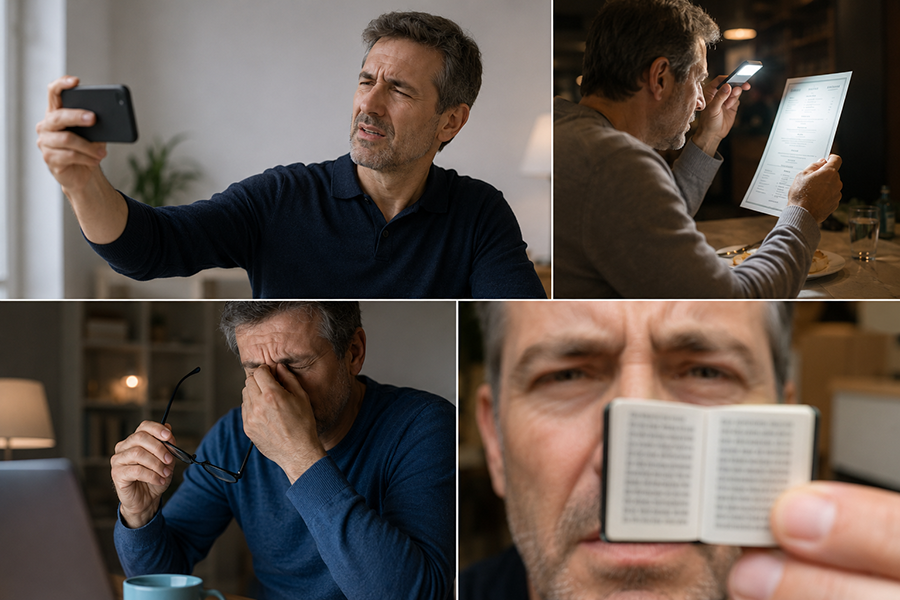
Holding your mobile phone further away to read a message. Needing more light to read a restaurant menu. Noticing that small print ‘dances’ before your eyes at the end of the day. If any of these scenarios sound familiar and you’re around 40–45 years old, you’re probably noticing the first signs of presbyopia, more commonly known as ‘age-related long-sightedness’.
What is presbyopia and why does it occur?
Presbyopia is neither a disease nor a defect: it is a natural part of the eye’s ageing process. Over the years, the crystalline lens — the eye’s internal lens that allows us to focus — loses flexibility, and the muscle that controls it loses some of its strength. The result is that it becomes increasingly difficult to focus on nearby objects.
This is why it tends to appear quite predictably around the age of 40–45, even in people who have never needed glasses before. It cannot be prevented, but it can be corrected very effectively.
Typical signs of presbyopia
- You need to hold text further away to focus on it (the classic ‘long arm’ gesture).
- You find it difficult to read in low light and need more lighting.
- You experience eye strain or a headache after reading or using your mobile phone for a while.
- It takes a few seconds to ‘focus’ when switching from looking at something in the distance to looking at something close up.
What solutions are available today
The good news is that there are more options available today than ever before, and not all of them involve ‘resigning yourself to reading glasses’. The main ones are:
- Glasses: from reading glasses to progressive lenses, which allow you to see clearly at all distances with a single lens.
- Contact lenses: there are multifocal contact lenses designed specifically for presbyopia.
- Surgery: in selected cases, surgery can reduce or eliminate the need for reading glasses. This is an option that must be assessed on an individual basis.
The key: a personalised assessment
There is no universal ‘best solution’ for presbyopia: there is the best solution for you, which depends on your prescription, your lifestyle, your work and your expectations. Someone who spends the day in front of screens does not need the same as someone who drives for many hours or plays sport.
That is why the first step is always the same: a comprehensive assessment that allows us to put all the options on the table and make an informed choice.
At the INOF Institute
At the INOF Institute, we assess presbyopia on an individual basis and clearly explain all the options available for your specific case. If you’ve started to notice that “you can no longer see up close as well as you used to”, we can help you regain comfort in your daily life.
Book your assessment at www.inofinstitut.com.
Temas relacionados